Secret Library Scenes Junk Journal Pages: Unveiling Creative Magic
There’s a distinct feeling you get when you crack open an old, leather-bound book in a dusty, forgotten corner of a library. It’s that mix of history, mystery, and tactile satisfaction that we often try to capture in our creative work. If you have been hunting for that specific aesthetic for your paper crafts, the Secret Library Scenes Junk Journal Pages collection is designed to bridge that gap between your imagination and the physical page. This isn’t just a set of generic backgrounds; it is a curated set of design assets intended to bring a narrative depth to your projects.
The Aesthetic: Old-World Charm Meets Modern Versatility
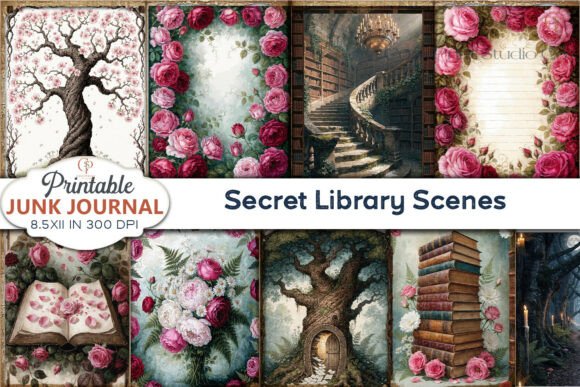
Visually, this collection leans heavily into a vintage, atmospheric style. We are talking about rich textures that mimic aged paper, intricate illustrations reminiscent of Victorian-era engravings, and a color palette that feels sepia-toned and warm. The personality of these pages is undeniably literary and introspective. It avoids the bright, flat look of modern vector art in favor of something that has more grit and soul. This makes them an exceptional choice for anyone looking to create a premium font aesthetic without relying solely on typography. The imagery acts as a standalone visual anchor.
Because these are high-resolution design assets (specifically 300 DPI), they hold up beautifully under scrutiny. You don't get the pixelation or blurriness that often plagues lower-quality freebies. This clarity is vital for print design, where the texture of the paper and the sharpness of the ink determine the perceived value of the final product. Whether you are using them as a full background for a journal spread or cutting them into smaller elements for collage, the integrity of the image remains intact.
Practical Applications for Designers and Crafters
When we look at where these scenes fit best, the applications are surprisingly broad. For the dedicated scrapbooker or junk journaler, the answer is obvious—these serve as the perfect backdrop for photos, ephemera, and handwritten notes. However, as a creative professional, I see potential far beyond the traditional journal.
Consider brand identity work. If you are building a brand for a boutique bookstore, a coffee roaster with a "literary" vibe, or a consultant who wants to project wisdom and history, these pages can be used to create texture in your packaging design. Imagine a business card where the back features a subtle, desaturated section of one of these library scenes. It immediately communicates a specific brand perception—one of depth, knowledge, and timelessness. It pairs exceptionally well with a classic serif font for body text or an elegant script font for headers.
For those in the digital space, specifically social media graphics, these images break the monotony of flat, corporate backgrounds. Using these scenes on Instagram or Pinterest can significantly boost audience engagement. People are drawn to details. A background that looks like it has a story to tell encourages viewers to pause their scrolling. This is particularly effective for authors, publishers, or content creators in the education sector.
Integration with Typography
A common challenge with busy, textured backgrounds is maintaining readability. This is where your choice of typeface becomes critical. Because the Secret Library Scenes Junk Journal Pages are intricate, you need to ensure your text doesn't fight with the background for attention.
I recommend using a sans serif font with good weight for body copy, as the clean lines will contrast nicely against the organic, "noisy" texture of the library imagery. If you are overlaying text, consider placing it inside a semi-transparent shape or a "knockout" box to ensure visual hierarchy is maintained. For headings, a bold display font works well, but be careful with overly complex handwritten fonts, as they might get lost in the illustration details.
Maximizing Your Digital Download
It is important to remember the technical specifications provided in this set. You are getting 10 distinct JPEG files sized at 8.5 x 11 inches. This standard letter size makes them immediately ready for home printing, which is a huge time-saver. However, don't let the format limit you.
Here are a few ways to manipulate these assets for DIY creative projects:
- Decoupage: Print these on thinner paper (like newsprint or laser printer paper) to make them easier to manipulate around the curves of jars or trays for mixed media art.
- Card Making: Crop specific elements—perhaps a stack of books or a window scene—to create focal points for greeting cards. This allows you to use a single page for multiple projects.
- Digital Collage: If you work in Procreate or Photoshop, use these as layers. Desaturate them or apply a "multiply" blend mode to layer them over other textures for a complex, aged look.
The flexibility of these creative font alternatives (meaning visual assets that serve a similar expressive purpose) allows for endless experimentation. Since this is a digital download, you can print the same scene multiple times to test different color treatments or cutting layouts without fear of running out of supply.
Evaluating Project Fit and Licensing
Before you dive in, take a moment to evaluate if this aesthetic fits your specific project goals. If your brand identity is ultra-modern, minimalist, and tech-focused, a vintage library scene might create cognitive dissonance for your audience. However, if your goal is to evoke nostalgia, intellect, or comfort, this collection hits the mark.
When integrating these into commercial work—such as selling finished junk journals or using them in client web design mockups—always review the usage rights. While these are standard digital files, understanding the distinction between personal use and commercial licensing is part of professional editorial design work. Generally, incorporating them into a new, unique design (like a collage or a background for a logo presentation) is standard practice, but selling the raw files as-is is usually prohibited.
Ultimately, the Secret Library Scenes Junk Journal Pages